Case Study
Dec 18, 2025

How The Luxury Closet Double Citations and Secure Its First AI Mentions in 90 days
Within 90 days, The Luxury Closet secured its first AI citations and mentions across ChatGPT, Google AI Overviews, and Perplexity. During the same period, TLC grew high-intent AI search traffic by 6× and increased generative visibility by 34%, moving from nearly invisible to consistently surfaced across key luxury queries.



Key Results
2xAverage citations and mentions | 6xGrowth in high-intent AI search traffic | 92%Engaged-session rate from GEO traffic |
Overview
The Luxury Closet (TLC) is a global marketplace for authenticated pre-owned luxury fashion, rapidly expanding its footprint across the UAE and broader Middle East. As the brand entered a critical growth phase, TLC partnered with Crossfill to accelerate traction and reinforce its position as one of the region’s most trusted luxury resale authorities.
Despite strong SEO investment and a robust content foundation, TLC confronted a new visibility gap: AI Answer Engines like ChatGPT, Google AI Overview, and Perplexity were quickly influencing luxury sales, yet TLC was nearly invisible across these platforms. To close this gap, TLC partnered with Crossfill to translate its editorial depth into machine-interpretable authority across AI discovery platforms.
As AI systems act as both discovery channels and attention competitors, being cited directly is essential to sustain traffic and trust. Recent empirical work shows that providing compact, verifiable passages and explicit source links increases the chance models will select and cite content, supporting the value of concise, evidence-forward formats for citation capture.
Analyzing TLC’s AI Visibility
Crossfill assessed how TLC’s content was being interpreted, surfaced, and credited across AI discovery platforms. The review focused on three areas: where the brand already appeared in luxury search journeys, where visibility gaps limited exposure, and how effectively content was positioned to capture high-intent resale and authentication demand.
Three primary insights emerged:

1. TLC Was Nearly Invisible Across AI Answers
AI visibility across major engines was below 1%, and competitors consistently dominated the high-intent luxury questions TLC should have owned. While TLC had credible editorial content, it did not explicitly reflect the core queries driving luxury research. Because these high-intent questions were not structurally represented, AI systems were unable to reliably associate them with TLC, limiting the brand’s presence in the moments where buyers seek authoritative guidance.
2. Inconsistent citation and authority signaling
Although TLC is widely recognized by consumers as a trusted luxury resale authority, generative engines did not consistently identify or credit the brand’s expertise. Competing publishers were cited more frequently, revealing a disconnect between TLC’s real-world authority and its machine-interpretable authority. This gap indicated that while TLC’s insights were strong, its content lacked the structural cues AI systems use to attribute expertise and assign citations. Recent research on citation evaluation (CiteEval) highlights that language models frequently struggle to produce correct and verifiable citations; improving on-page provenance, explicit sourcing, and tightly scoped claims materially helps downstream attribution quality in retrieval-augmented and generative systems.
3. Product-centric positioning limited visibility
TLC’s content often surfaced in contexts tied to product exploration rather than informational guidance. As AI systems increasingly elevated expert reasoning and decision support, content that focused primarily on listings without consistently anchoring educational value was less likely to be positioned as authoritative across AI discovery platforms.
Crossfill Recommendations
Based on these insights, Crossfill delivered a structured roadmap designed to expand TLC’s authority across AI discovery platforms and ensure the brand was consistently surfaced and credited. The recommendations aligned directly with the GEO strategy: treating AI as a distinct discovery channel, not an SEO add-on, and optimizing for how generative systems read, interpret, and attribute expertise. For more on this approach, see our related case study, How Cerebro Achieved over 15x Growth in Visibility with Crossfill.
1. Strengthen alignment with real buyer questions
Prioritize optimization around the questions and topics that reflect real luxury-buyer discovery behavior. Deepen focus on the value factors customers prioritize, ensuring content aligns naturally with their decision flow and purchase intent. This approach helps AI systems better understand and match TLC’s content to qualified, high-intent queries from key customers.
2. Enhance authority signals to support consistent attributions
Refine content structure and contextual cues to clearly position TLC as a leading authority in luxury resale and authentication. Strengthen the signals that help AI models identify expert guidance and attribute insights appropriately, reinforcing TLC’s role as a trusted source for high-intent shoppers and AI platforms alike.
3. Pair product highlights with insight-driven context
Layer structured guidance alongside product visibility to support how customers evaluate quality, authenticity, and fit for their needs. Position content to not only showcase products but also offer perspective, context, and value-driven rationale that AI engines prefer to cite.
Combine product attributes with buyer guidance, including size guides, materials, care, resale value retention, warranty considerations, and return policy clarity.
Ensure price, availability, and compatibility data are explicit to reduce ambiguity for answer engines.
How TLC Took Action
With Crossfill’s guidance, TLC applied these refinements across priority content to strengthen how its expertise is interpreted and surfaced in AI-driven discovery. The updates focused on sharpening clarity, reinforcing decision logic, and aligning content more closely with the key moments that influence luxury resale consideration and trust.
1. Optimizations aligned to luxury research queries
Evergreen content was re-structured to reflect real buyer exploration paths. This included clearer flow, stronger informational framing, and more defined question-and-answer structures. These updates helped TLC surface more frequently for high-intent queries across both consumer search and AI-driven answers.
2. Reinforced authority positioning and attribution clarity
On-page signals, contextual language, and expert framing were refined to make TLC’s knowledge easier for AI systems to identify and attribute. This supported more consistent recognition and citation across luxury resale and authentication queries.
3. Paired product expertise with structured buyer guidance
While maintaining its strong product expertise, TLC layered in clearer informational structure and context to strengthen buyer confidence. This improved how AI systems interpret and surface TLC’s insights in reasoning-led environments, supporting greater inclusion in guidance-oriented responses beyond purely product exposure surfaces.
TLC’s Results with Crossfill
The collaboration delivered sustained and measurable gains across all core visibility and engagement metrics. Optimized articles consistently achieved stronger placement and recognition across leading AI discovery platforms like ChatGPT, Google AI Overview, and Perplexity. For additional examples of GEO outcomes, explore the Crossfill blog.
Citations and Mentions
All optimized content achieved at least a 2× growth in citations and mentions, supported by a +34% lift in AI visibility across high-intent luxury queries. TLC’s expertise became more consistently recognized and surfaced in AI-generated answers across ChatGPT, Google AI Overviews, and Perplexity.
Result highlights:
The Handbags Worth Investing guide experienced a 300% lift in AI visibility, driven by a 200% jump in citations.
The Best Dior Bags guide achieved a 650% overall lift, earning its first-ever AI mentions and establishing stronger authority in its category..
The Investment-Worthy Everyday Bags also secured its first AI citations and mentions, signaling improved query alignment and growing recognition across platforms.
Engagement and Revenue
AI-sourced visitors not only arrived in greater volume, they also showed stronger purchase intent and commercially meaningful conversion behavior. Traffic from generative platforms sustained a 92% engagement rate, defined as the percentage of visitors who interacted meaningfully with the content through actions such as scrolling, clicking into product paths, exploring resale guidance, or continuing deeper into the site experience.
Average engagement time across all platforms increased, with certain AI platforms extending past a minute — far above typical top-of-funnel benchmarks. Engaged sessions per active user also increased, and bounce rates declined, reinforcing the overall lift in traffic quality driven by generative visibility.
These patterns collectively point to generative discovery emerging as a net-new, high-intent acquisition channel for The Luxury Closet.
GEO Traffic Performance
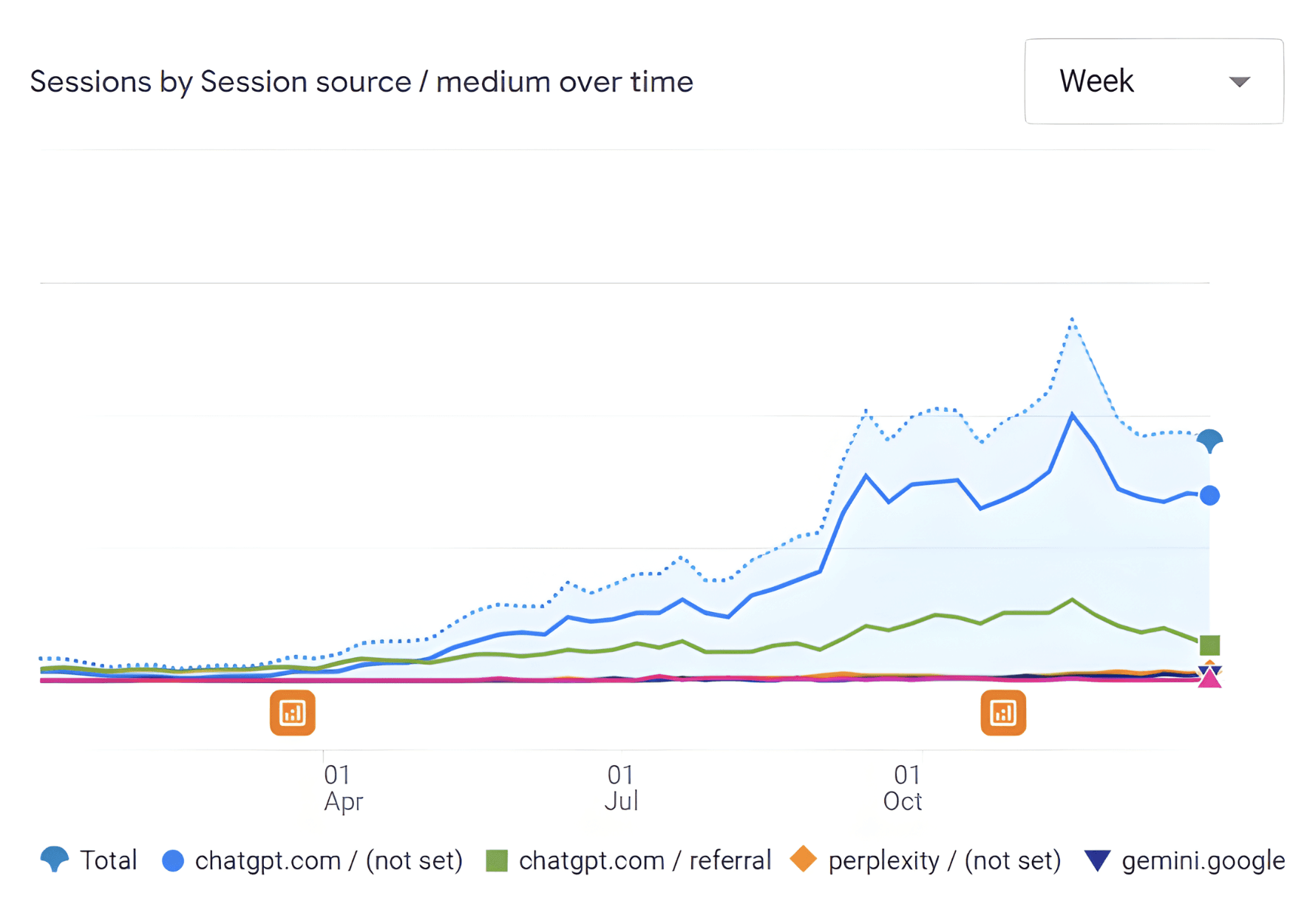
Improved generative visibility translated directly into qualified traffic lift. Weekly sessions attributed to AI-driven discovery increased from fewer than 100 to more than 2,000, reflecting a clear surge in high-intent luxury demand and search-driven purchase exploration.
The chart below visualizes performance across the three leading AI discovery platforms: ChatGPT, Gemini, and Perplexity.
Outcome
The Luxury Closet and Crossfill partnership demonstrates how structured content refinement can turn editorial strength into measurable AI visibility and commercial performance. By aligning with real luxury search behavior and reinforcing machine-readable cues, TLC achieved 6× growth in high-intent AI search traffic, 2× more citations and mentions across generative platforms, and a new stream of revenue.
By treating AI as its own acquisition channel, TLC optimized for how generative systems reason, attribute, and recommend, boosting visibility across ChatGPT, Google AI Overviews, and Perplexity. Crossfill empowers brands to translate their expertise into lasting visibility and authority across the next generation of search.
“We went from invisible to owning key answers in just a few months”
-Kara Moddemann, VP Marketing & Growth @ TLC
FAQs: AI Citations, GEO, and Luxury Resale Visibility
What content optimization strategies help a luxury fashion marketplace get cited by ChatGPT and Google AI Overviews
Prioritize answer-first summaries, explicit product attributes, and specific statistics that AI can verify. Use entity signals like “sameAs” links and authoritative outbound references. Crossfill’s GEO approach focuses on aligning content with conversational buyer questions and has delivered measurable results for TLC and other clients featured on the Crossfill blog.
Why is my authenticated pre-owned luxury brand invisible in generative AI answers despite strong SEO
Traditional SEO alone may not provide the machine-readable signals AI engines need. Generative platforms weigh structured data, expert framing, and third-party mentions heavily. Crossfill often finds that brands underuse schema, lack Q&A formatting, and do not surface evidence-rich claims. Addressing these gaps improves both citation frequency and attribution accuracy.
How to align editorial luxury content with high-intent buyer questions to boost AI visibility
Map content to natural-language questions buyers ask before they visit your site, such as “How does authentication work for Dior Saddle Bags” or “Which Hermès sandals are most comfortable.” Lead with a two-sentence answer, then provide structured detail. Crossfill helps teams build these question clusters and validate them through platform checks in ChatGPT, Perplexity, and Google AI Overviews.
What on-page authority signals and contextual cues encourage AI platforms to attribute expertise to a resale brand
Signals include expert bylines, clear sourcing, recency dates, and schema coverage for Article and FAQPage. Product pages should expose attributes, availability, returns, shipping, size guides, and ratings. Crossfill’s guidance emphasizes E-E-A-T, consistent citation of statistics, and internal links to cornerstone guides, which collectively increase AI-level trust.
How to pair product listings with structured buyer guidance so generative models surface my brand for authentication queries
Combine listing data with short buyer guides that explain authentication checks, common counterfeits, material identifiers, pricing bands, and return policy details. TLC added this context and saw improved inclusion in reasoning-led responses. Crossfill can provide a tailored content plan through a personalized walkthrough.
How does improving AI visibility from generative platforms drive engagement and revenue for high-consideration luxury commerce
AI-driven discovery can lift revenue meaningfully. Studies report large gains from AI-driven recommendations, and brands often see higher conversion rates and average order values when guidance is aligned to buyer intent. TLC recorded a 92% engaged-session rate from GEO traffic after working with Crossfill.
When should a luxury marketplace treat AI as a distinct discovery channel rather than an SEO add-on
Treat AI as its own channel when high-intent queries are no longer producing consistent SERP clicks or when AI Overviews dominate results. Crossfill’s GEO strategy addresses platform-specific optimization, brand mentions, and citation capture, as detailed in the Cerebro case study.
Where can I learn more about Crossfill’s approach or speak with an expert
Visit Crossfill for an overview, browse the blog for additional case studies, or request a personalized walkthrough. For privacy and compliance information, see the Privacy Policy and Terms of Service.
Key Results
2xAverage citations and mentions | 6xGrowth in high-intent AI search traffic | 92%Engaged-session rate from GEO traffic |
Overview
The Luxury Closet (TLC) is a global marketplace for authenticated pre-owned luxury fashion, rapidly expanding its footprint across the UAE and broader Middle East. As the brand entered a critical growth phase, TLC partnered with Crossfill to accelerate traction and reinforce its position as one of the region’s most trusted luxury resale authorities.
Despite strong SEO investment and a robust content foundation, TLC confronted a new visibility gap: AI Answer Engines like ChatGPT, Google AI Overview, and Perplexity were quickly influencing luxury sales, yet TLC was nearly invisible across these platforms. To close this gap, TLC partnered with Crossfill to translate its editorial depth into machine-interpretable authority across AI discovery platforms.
As AI systems act as both discovery channels and attention competitors, being cited directly is essential to sustain traffic and trust. Recent empirical work shows that providing compact, verifiable passages and explicit source links increases the chance models will select and cite content, supporting the value of concise, evidence-forward formats for citation capture.
Analyzing TLC’s AI Visibility
Crossfill assessed how TLC’s content was being interpreted, surfaced, and credited across AI discovery platforms. The review focused on three areas: where the brand already appeared in luxury search journeys, where visibility gaps limited exposure, and how effectively content was positioned to capture high-intent resale and authentication demand.
Three primary insights emerged:
1. TLC Was Nearly Invisible Across AI Answers
AI visibility across major engines was below 1%, and competitors consistently dominated the high-intent luxury questions TLC should have owned. While TLC had credible editorial content, it did not explicitly reflect the core queries driving luxury research. Because these high-intent questions were not structurally represented, AI systems were unable to reliably associate them with TLC, limiting the brand’s presence in the moments where buyers seek authoritative guidance.
2. Inconsistent citation and authority signaling
Although TLC is widely recognized by consumers as a trusted luxury resale authority, generative engines did not consistently identify or credit the brand’s expertise. Competing publishers were cited more frequently, revealing a disconnect between TLC’s real-world authority and its machine-interpretable authority. This gap indicated that while TLC’s insights were strong, its content lacked the structural cues AI systems use to attribute expertise and assign citations. Recent research on citation evaluation (CiteEval) highlights that language models frequently struggle to produce correct and verifiable citations; improving on-page provenance, explicit sourcing, and tightly scoped claims materially helps downstream attribution quality in retrieval-augmented and generative systems.
3. Product-centric positioning limited visibility
TLC’s content often surfaced in contexts tied to product exploration rather than informational guidance. As AI systems increasingly elevated expert reasoning and decision support, content that focused primarily on listings without consistently anchoring educational value was less likely to be positioned as authoritative across AI discovery platforms.
Crossfill Recommendations
Based on these insights, Crossfill delivered a structured roadmap designed to expand TLC’s authority across AI discovery platforms and ensure the brand was consistently surfaced and credited. The recommendations aligned directly with the GEO strategy: treating AI as a distinct discovery channel, not an SEO add-on, and optimizing for how generative systems read, interpret, and attribute expertise. For more on this approach, see our related case study, How Cerebro Achieved over 15x Growth in Visibility with Crossfill.
1. Strengthen alignment with real buyer questions
Prioritize optimization around the questions and topics that reflect real luxury-buyer discovery behavior. Deepen focus on the value factors customers prioritize, ensuring content aligns naturally with their decision flow and purchase intent. This approach helps AI systems better understand and match TLC’s content to qualified, high-intent queries from key customers.
2. Enhance authority signals to support consistent attributions
Refine content structure and contextual cues to clearly position TLC as a leading authority in luxury resale and authentication. Strengthen the signals that help AI models identify expert guidance and attribute insights appropriately, reinforcing TLC’s role as a trusted source for high-intent shoppers and AI platforms alike.
3. Pair product highlights with insight-driven context
Layer structured guidance alongside product visibility to support how customers evaluate quality, authenticity, and fit for their needs. Position content to not only showcase products but also offer perspective, context, and value-driven rationale that AI engines prefer to cite.
Combine product attributes with buyer guidance, including size guides, materials, care, resale value retention, warranty considerations, and return policy clarity.
Ensure price, availability, and compatibility data are explicit to reduce ambiguity for answer engines.
How TLC Took Action
With Crossfill’s guidance, TLC applied these refinements across priority content to strengthen how its expertise is interpreted and surfaced in AI-driven discovery. The updates focused on sharpening clarity, reinforcing decision logic, and aligning content more closely with the key moments that influence luxury resale consideration and trust.
1. Optimizations aligned to luxury research queries
Evergreen content was re-structured to reflect real buyer exploration paths. This included clearer flow, stronger informational framing, and more defined question-and-answer structures. These updates helped TLC surface more frequently for high-intent queries across both consumer search and AI-driven answers.
2. Reinforced authority positioning and attribution clarity
On-page signals, contextual language, and expert framing were refined to make TLC’s knowledge easier for AI systems to identify and attribute. This supported more consistent recognition and citation across luxury resale and authentication queries.
3. Paired product expertise with structured buyer guidance
While maintaining its strong product expertise, TLC layered in clearer informational structure and context to strengthen buyer confidence. This improved how AI systems interpret and surface TLC’s insights in reasoning-led environments, supporting greater inclusion in guidance-oriented responses beyond purely product exposure surfaces.
TLC’s Results with Crossfill
The collaboration delivered sustained and measurable gains across all core visibility and engagement metrics. Optimized articles consistently achieved stronger placement and recognition across leading AI discovery platforms like ChatGPT, Google AI Overview, and Perplexity. For additional examples of GEO outcomes, explore the Crossfill blog.
Citations and Mentions
All optimized content achieved at least a 2× growth in citations and mentions, supported by a +34% lift in AI visibility across high-intent luxury queries. TLC’s expertise became more consistently recognized and surfaced in AI-generated answers across ChatGPT, Google AI Overviews, and Perplexity.
Result highlights:
The Handbags Worth Investing guide experienced a 300% lift in AI visibility, driven by a 200% jump in citations.
The Best Dior Bags guide achieved a 650% overall lift, earning its first-ever AI mentions and establishing stronger authority in its category..
The Investment-Worthy Everyday Bags also secured its first AI citations and mentions, signaling improved query alignment and growing recognition across platforms.
Engagement and Revenue
AI-sourced visitors not only arrived in greater volume, they also showed stronger purchase intent and commercially meaningful conversion behavior. Traffic from generative platforms sustained a 92% engagement rate, defined as the percentage of visitors who interacted meaningfully with the content through actions such as scrolling, clicking into product paths, exploring resale guidance, or continuing deeper into the site experience.
Average engagement time across all platforms increased, with certain AI platforms extending past a minute — far above typical top-of-funnel benchmarks. Engaged sessions per active user also increased, and bounce rates declined, reinforcing the overall lift in traffic quality driven by generative visibility.
These patterns collectively point to generative discovery emerging as a net-new, high-intent acquisition channel for The Luxury Closet.
GEO Traffic Performance
Improved generative visibility translated directly into qualified traffic lift. Weekly sessions attributed to AI-driven discovery increased from fewer than 100 to more than 2,000, reflecting a clear surge in high-intent luxury demand and search-driven purchase exploration.
The chart below visualizes performance across the three leading AI discovery platforms: ChatGPT, Gemini, and Perplexity.

Outcome
The Luxury Closet and Crossfill partnership demonstrates how structured content refinement can turn editorial strength into measurable AI visibility and commercial performance. By aligning with real luxury search behavior and reinforcing machine-readable cues, TLC achieved 6× growth in high-intent AI search traffic, 2× more citations and mentions across generative platforms, and a new stream of revenue.
By treating AI as its own acquisition channel, TLC optimized for how generative systems reason, attribute, and recommend, boosting visibility across ChatGPT, Google AI Overviews, and Perplexity. Crossfill empowers brands to translate their expertise into lasting visibility and authority across the next generation of search.
“We went from invisible to owning key answers in just a few months”
-Kara Moddemann, VP Marketing & Growth @ TLC
FAQs: AI Citations, GEO, and Luxury Resale Visibility
What content optimization strategies help a luxury fashion marketplace get cited by ChatGPT and Google AI Overviews
Prioritize answer-first summaries, explicit product attributes, and specific statistics that AI can verify. Use entity signals like “sameAs” links and authoritative outbound references. Crossfill’s GEO approach focuses on aligning content with conversational buyer questions and has delivered measurable results for TLC and other clients featured on the Crossfill blog.
Why is my authenticated pre-owned luxury brand invisible in generative AI answers despite strong SEO
Traditional SEO alone may not provide the machine-readable signals AI engines need. Generative platforms weigh structured data, expert framing, and third-party mentions heavily. Crossfill often finds that brands underuse schema, lack Q&A formatting, and do not surface evidence-rich claims. Addressing these gaps improves both citation frequency and attribution accuracy.
How to align editorial luxury content with high-intent buyer questions to boost AI visibility
Map content to natural-language questions buyers ask before they visit your site, such as “How does authentication work for Dior Saddle Bags” or “Which Hermès sandals are most comfortable.” Lead with a two-sentence answer, then provide structured detail. Crossfill helps teams build these question clusters and validate them through platform checks in ChatGPT, Perplexity, and Google AI Overviews.
What on-page authority signals and contextual cues encourage AI platforms to attribute expertise to a resale brand
Signals include expert bylines, clear sourcing, recency dates, and schema coverage for Article and FAQPage. Product pages should expose attributes, availability, returns, shipping, size guides, and ratings. Crossfill’s guidance emphasizes E-E-A-T, consistent citation of statistics, and internal links to cornerstone guides, which collectively increase AI-level trust.
How to pair product listings with structured buyer guidance so generative models surface my brand for authentication queries
Combine listing data with short buyer guides that explain authentication checks, common counterfeits, material identifiers, pricing bands, and return policy details. TLC added this context and saw improved inclusion in reasoning-led responses. Crossfill can provide a tailored content plan through a personalized walkthrough.
How does improving AI visibility from generative platforms drive engagement and revenue for high-consideration luxury commerce
AI-driven discovery can lift revenue meaningfully. Studies report large gains from AI-driven recommendations, and brands often see higher conversion rates and average order values when guidance is aligned to buyer intent. TLC recorded a 92% engaged-session rate from GEO traffic after working with Crossfill.
When should a luxury marketplace treat AI as a distinct discovery channel rather than an SEO add-on
Treat AI as its own channel when high-intent queries are no longer producing consistent SERP clicks or when AI Overviews dominate results. Crossfill’s GEO strategy addresses platform-specific optimization, brand mentions, and citation capture, as detailed in the Cerebro case study.
Where can I learn more about Crossfill’s approach or speak with an expert
Visit Crossfill for an overview, browse the blog for additional case studies, or request a personalized walkthrough. For privacy and compliance information, see the Privacy Policy and Terms of Service.