Case Study
Jan 9, 2026
How TicketSmarter 3×’d AI Visibility and Ranked above Ticketmaster
In three months, TicketSmarter increased AI visibility by 2.92×, saw up to 10× more AI mentions and 5.5× more citations — including wins against Ticketmaster. Backed by a GEO approach and machine‑readable fixes, results compounded across ChatGPT, Google AI Overviews, and Perplexity, then echoed in Google Search Console.

Key Results
233%Lift in Mentions | 192%Lift in Overall AI Visibility | 182%Lift in Citations |
|---|
Faster AI recognition: citations and quotes added to priority guides are proven levers for AI selection
Higher authority density: venue and festival pages mapped to high‑intent queries with clearer entity and brand signals
Better machine readability: structured context and clean metadata improved snippet lift and cross‑agent extractability
Explore the methodology behind these outcomes on Crossfill and see repeatable performance in our related case study, How Cerebro Achieved over 15× Growth in Visibility.
Overview
TicketSmarter is a major U.S. ticketing marketplace serving fans across concerts, sports, festivals, and theater events nationwide. As more users began turning to conversational queries inside ChatGPT, Google AI Overviews, and Perplexity, the team saw a clear shift in how event research was happening. Fans were asking these systems broad and highly popular questions that TicketSmarter already addressed within its guides, yet those guides were not appearing in the answers.
The team partnered with Crossfill to uncover where visibility was breaking down and to identify opportunities to strengthen recognition across the full discovery landscape. The goal was to ensure TicketSmarter appears wherever today’s event-goers begin planning their experiences.
AI selection increasingly favors sites with strong entity clarity, fresh content, and transparent sourcing. Research shows that pages with explicit citations and quotations tend to outperform comparable pages without them. Crossfill’s work emphasized these extractable elements while improving machine readability and topical alignment.
Analysis & Recommendations
1. High‑value guides had limited search visibility
Crossfill found that several of TicketSmarter’s most important guides had little or no presence in search results. Without impressions or rankings, these pages also went unrecognized in the AI answer layer. Because both surfaces rely on similar relevance signals, Crossfill recommended strengthening the authority and machine readability of these assets so Google and AI systems could better interpret and surface them.
What changed:
Added explicit citations and concise quotations near the top for liftable facts
Clarified entity references so venues, neighborhoods, and events were unambiguous to AI parsers
Improved metadata and descriptive headings to match long‑tail, question‑based queries
These changes align with findings that citations and statistics materially improve AI visibility and that 65% of AI bot traffic targets content published within the past year; an industry analysis of thousands of URLs cited by ChatGPT, Perplexity, and AI Overviews found about 65% of AI “hits” targeted content published in the prior year, confirming strong recency effects in AI citation behavior (AI Brand Visibility and Content Recency).
2. AI systems weren’t recognizing TicketSmarter’s expertise
Although TicketSmarter had strong content around venues, festivals, and ticketing behavior, AI engines frequently cited major publishers or Ticketmaster instead. The issue wasn’t the content quality but how engines interpreted authority. Crossfill clarified these topical relationships so AI systems could map TicketSmarter’s guides to high‑intent queries more accurately and reinforce recognition across the discovery ecosystem.
What changed:
Reinforced brand and entity associations across guides, internal links, and references
Increased citation density from credible sources to strengthen knowledge‑graph trust
Ensured public accessibility, fixed broken links, and removed rendering obstacles that suppress agent extraction
These authority fixes support stronger brand‑topic associations, a leading predictor of AI visibility. Google’s guidance on structured data and machine‑readable content emphasizes using clear, indexable markup and visible page content to improve extractability and inclusion in AI answer surfaces; specifically, Google updated how FAQ and HowTo markup is treated and recommends valid schema plus visible HTML for rich features and AI extraction (Changes to HowTo and FAQ rich results).
How TicketSmarter Took Action
TicketSmarter applied Crossfill’s visibility guidance to its highest‑value guides. As optimization rolled out, AI engines began referencing the pages more consistently. Google Search Console soon echoed this shift, showing a parallel rise in impressions, clicks, and ranking strength.
Madison Square Garden Event Guide
Using Crossfill’s GEO approach, TicketSmarter refined the guide to make venue navigation, event expectations, and ticketing behavior clearer for AI interpretation. As engines began recognizing the guide’s relevance, visibility increased across ChatGPT, Google AI Overview, and Perplexity for broad MSG‑related queries. Adding structured cues, clean FAQ blocks, and a short, liftable summary helped assistant models extract answers.
AI Performance
10× increase in mentions
3.25× increase in citations
3.62× lift in overall AI visibility
Below is a snapshot of these top citations inside ChatGPT:
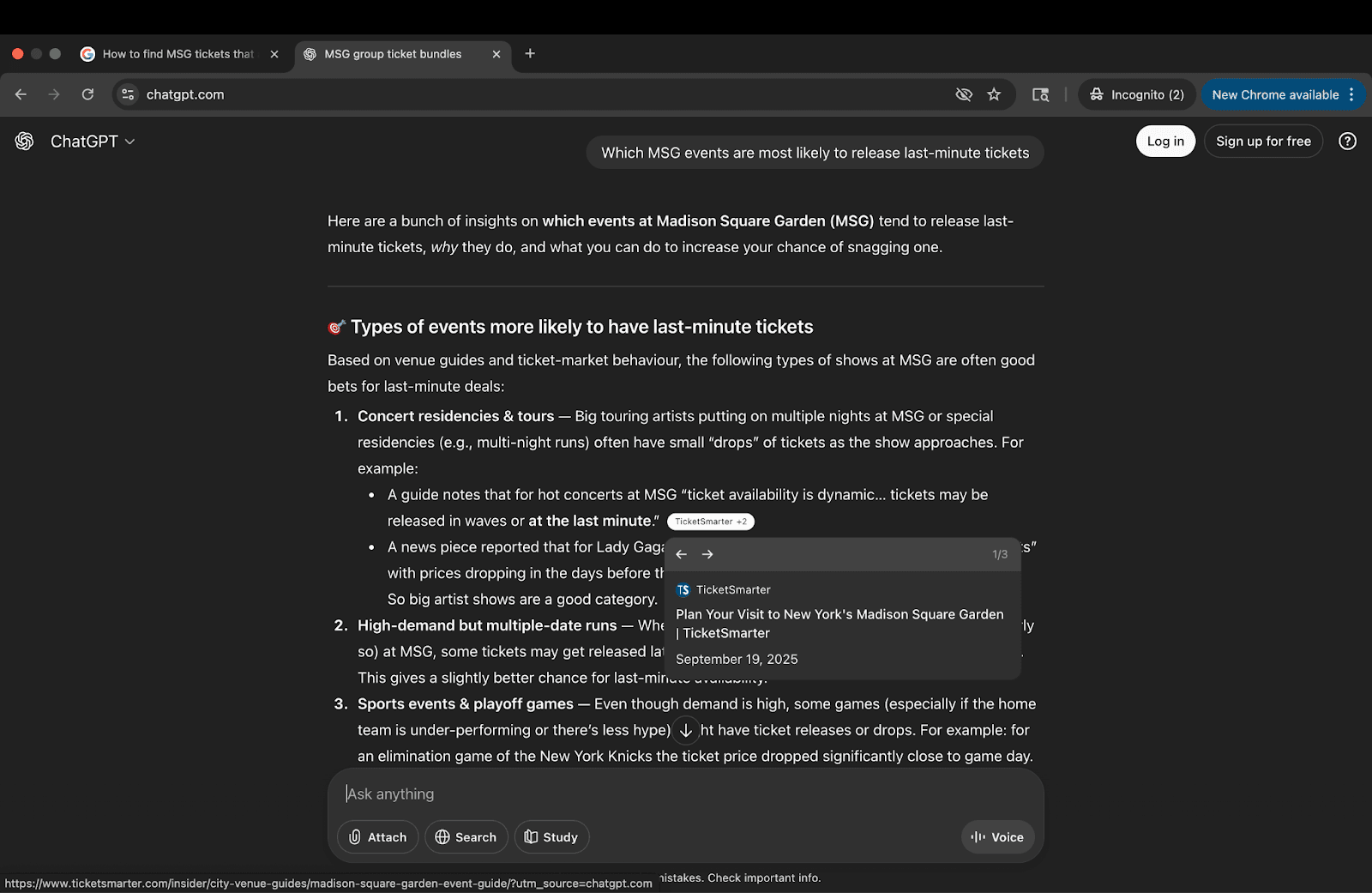
How AI Visibility Lifted SEO Visibility
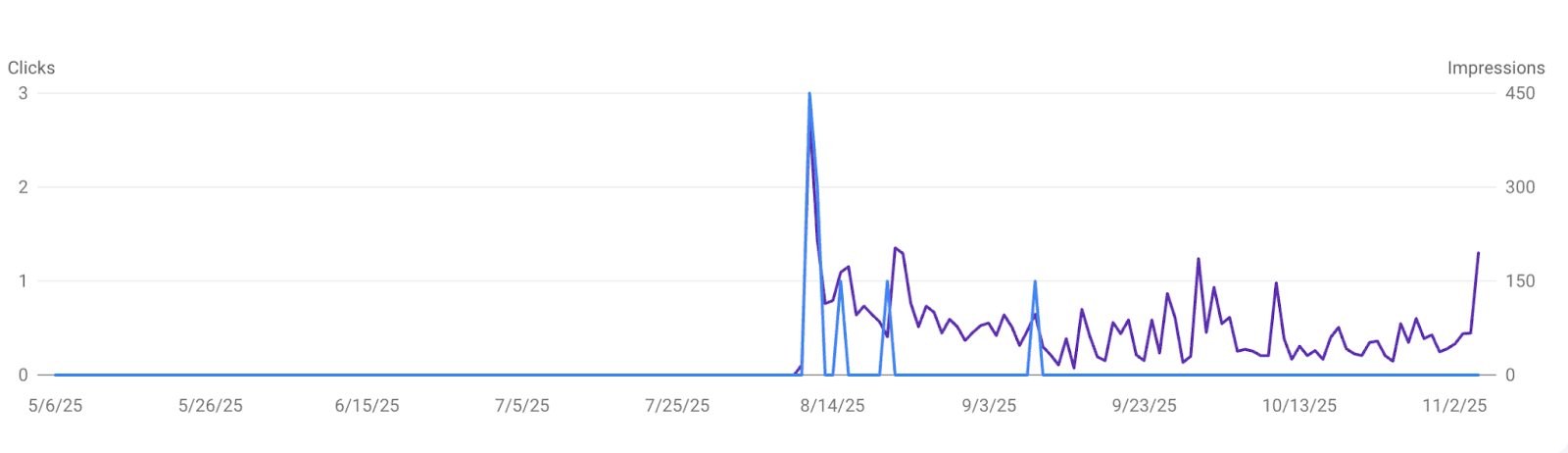
Google Search Console showed the same pattern. The MSG guide recorded:
4× increase in total clicks
2× increase in impressions
Average position improved from 9.5 → 5.8, moving above the fold
Broad generic queries such as “madison square garden seating chart” and “msg seating chart” also surged. The GSC graph below marks the republish date, with a clear and immediate lift that continued to grow.

Example 2: Outside Lands Festival Guide
The Outside Lands guide began with no measurable presence — zero impressions, zero clicks, and no rankings in either search or AI systems. After Crossfill’s optimization, the page started appearing across multiple AI platforms, including for competitive, non‑branded festival queries. Fresh content and extractable stats were added to match how AI assistants compose answers.
AI Performance
5.5× increase in citations
3× increase in mentions
5.5× lift in overall visibility
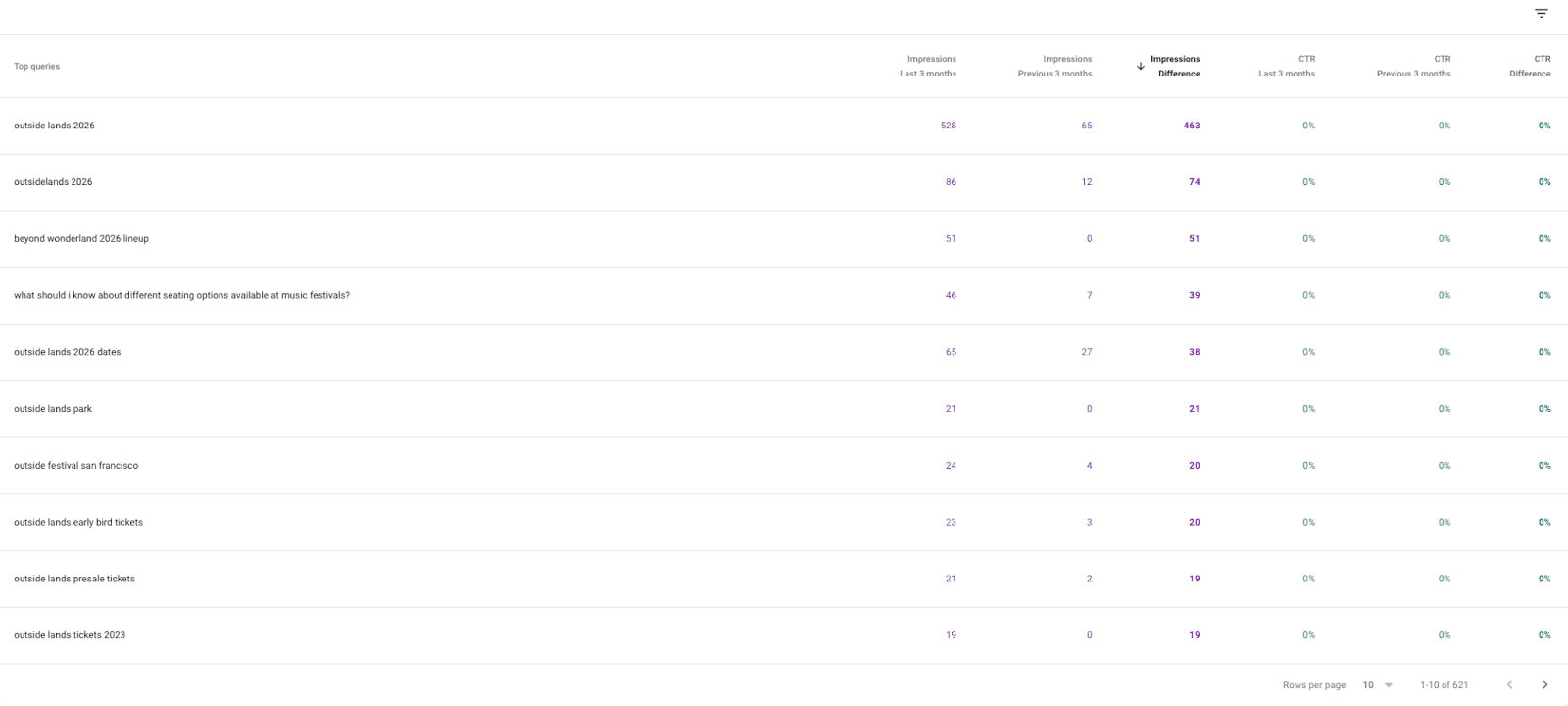
Google Search Console reflected the same acceleration almost immediately. Impressions rose from 0 to 6,820, and the page generated its first recorded clicks and rankings. As the lift stabilized, average position settled at 25.1, a substantial improvement from having no ranking at all.
One notable gain came from the high‑demand query “outside lands 2026,” which jumped from 65 to 528 impressions — an 8× increase.
Results: Outranking TicketMaster
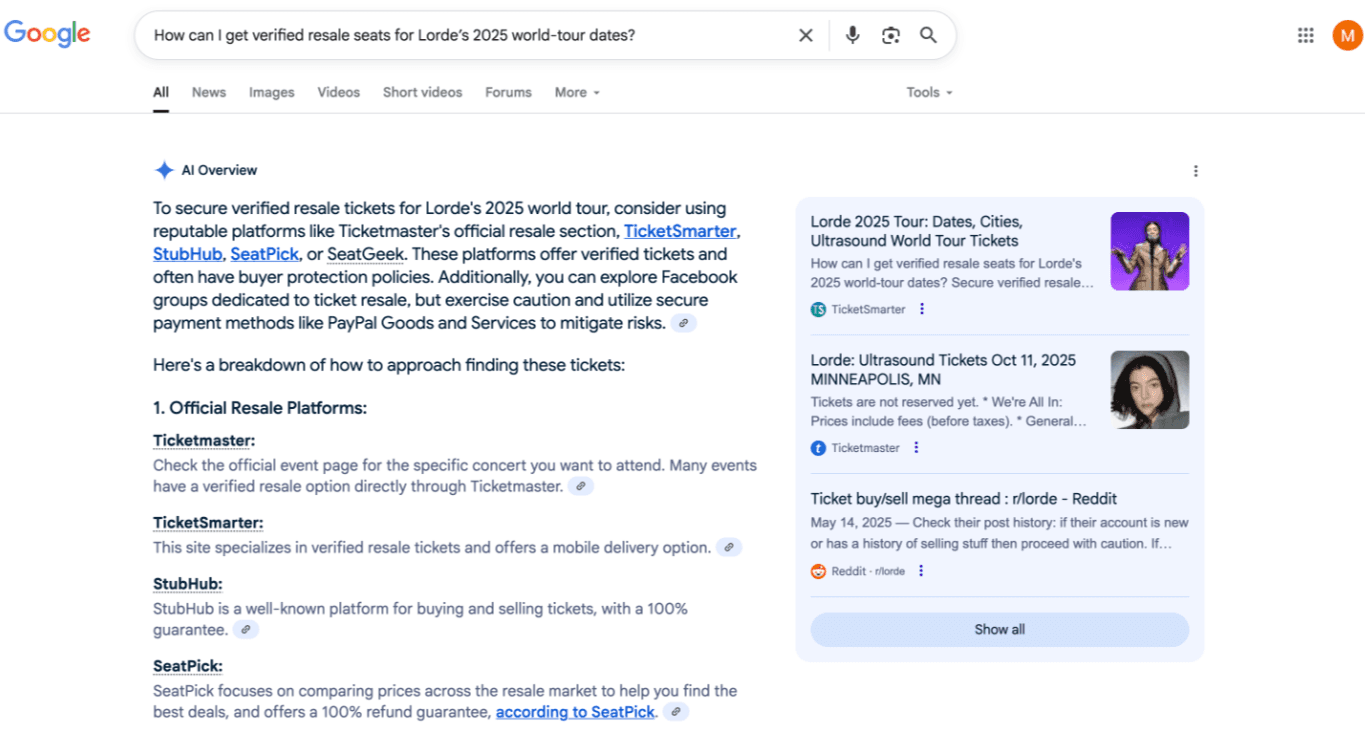
A clear milestone came when TicketSmarter appeared above TicketMaster in Google’s AI Overview for the competitive query:
“Where to get verified seats for Lorde’s 2025 tour dates.”
Given the enormous search demand around major artist tours and TicketMaster’s long‑standing dominance, this was a breakthrough moment. Google chose TicketSmarter’s guide because it offered clearer explanations, stronger alignment with the query, and more authoritative guidance for the user. Below is the example showing TicketSmarter earning the top position above their largest competitor.
Outcome
Crossfill’s optimization created a meaningful shift in TicketSmarter’s performance. As AI engines began incorporating the refined guides, Google Search Console reflected the same rise in authority with sustained increases in impressions, clicks, and ranking strength. Pages that once had minimal visibility now appear consistently across both AI answer layers and traditional search, even outperforming Ticketmaster on competitive queries.
Crossfill’s framework did more than improve content quality. It expanded TicketSmarter’s reach, strengthened its position in a crowded market, and set in motion momentum that continues to compound. To learn how this approach applies across verticals, visit the Crossfill blog or review a related case study, How Cerebro Achieved over 15× Growth in Visibility. If you want to discuss this playbook, contact our team via Crossfill.
“As AI-driven discovery became a primary way fans research events, improving our visibility across systems like ChatGPT and Google AI Overviews became a priority for TicketSmarter. Partnering with Crossfill gave us a clear, data-backed understanding of where our guides were falling short and how to fix it. In just three months, we nearly tripled AI visibility, drove up to 10× more mentions and 5× more citations, and even surpassed Ticketmaster on competitive queries. The impact has been measurable, repeatable, and continues to compound across both AI and search.”
- Nicholas Dimmitt, Director of Marketing at TicketSmarter
FAQs
What optimization steps improve AI answer layer recognition?
Start with a top‑loaded summary, add authoritative citations and statistics, and use question‑based headings. Reinforce entity clarity and ensure pages load fast and are publicly accessible. Crossfill recommends structured, liftable blocks and regular refresh cycles to match AI recency bias.
Why are high‑value content missing from AI summaries and how can visibility be restored?
Common blockers include weak entity mapping, low citation density, poor extractability, and stale content. Restoring visibility requires citations, quotations, clean metadata, predictable structure, and explicit venue entities. Crossfill’s findings indicate quotations and statistics improve AI selection, and brand‑topic association is an early visibility predictor.
What steps convert zero‑impression content into pages appearing across ChatGPT, Perplexity, and Google AI?
Apply structured Q&A, extractable facts, citations, quotes, and accurate metadata. Refresh content and request re‑indexing. For example, TicketSmarter’s Outside Lands page moved from zero impressions to 6,820 impressions with first recorded clicks after these steps.
How does improving machine readability and topical clarity lift both AI visibility and Google Search Console metrics?
AI assistants favor content with clear sections, bullets, and concise summaries. These same improvements help search engines understand and rank pages. In this case, lifts in mentions and citations preceded sustained increases in clicks, impressions, and average position.
What recommendations help a site win AI Overview placements against larger competitors?
Focus on GEO‑aligned guides with consistent entities, fresh updates, and transparent sourcing. Add citations and quotes near the top, and ensure fast load times. Crossfill’s framework combines authority signals with structured, liftable content to close the gap with incumbents.
How can applying a visibility framework increase AI mentions, citations, and sustainable search momentum?
Prioritize machine readability, entity clarity, and citation density on your highest‑value pages. Track AI citations and snippet wins monthly, refresh content frequently, and expand the approach to additional guides. For examples across industries, visit Crossfill or browse the Crossfill blog.
Key Results
233%Lift in Mentions | 192%Lift in Overall AI Visibility | 182%Lift in Citations |
|---|
Faster AI recognition: citations and quotes added to priority guides are proven levers for AI selection
Higher authority density: venue and festival pages mapped to high‑intent queries with clearer entity and brand signals
Better machine readability: structured context and clean metadata improved snippet lift and cross‑agent extractability
Explore the methodology behind these outcomes on Crossfill and see repeatable performance in our related case study, How Cerebro Achieved over 15× Growth in Visibility.
Overview
TicketSmarter is a major U.S. ticketing marketplace serving fans across concerts, sports, festivals, and theater events nationwide. As more users began turning to conversational queries inside ChatGPT, Google AI Overviews, and Perplexity, the team saw a clear shift in how event research was happening. Fans were asking these systems broad and highly popular questions that TicketSmarter already addressed within its guides, yet those guides were not appearing in the answers.
The team partnered with Crossfill to uncover where visibility was breaking down and to identify opportunities to strengthen recognition across the full discovery landscape. The goal was to ensure TicketSmarter appears wherever today’s event-goers begin planning their experiences.
AI selection increasingly favors sites with strong entity clarity, fresh content, and transparent sourcing. Research shows that pages with explicit citations and quotations tend to outperform comparable pages without them. Crossfill’s work emphasized these extractable elements while improving machine readability and topical alignment.
Analysis & Recommendations
1. High‑value guides had limited search visibility
Crossfill found that several of TicketSmarter’s most important guides had little or no presence in search results. Without impressions or rankings, these pages also went unrecognized in the AI answer layer. Because both surfaces rely on similar relevance signals, Crossfill recommended strengthening the authority and machine readability of these assets so Google and AI systems could better interpret and surface them.
What changed:
Added explicit citations and concise quotations near the top for liftable facts
Clarified entity references so venues, neighborhoods, and events were unambiguous to AI parsers
Improved metadata and descriptive headings to match long‑tail, question‑based queries
These changes align with findings that citations and statistics materially improve AI visibility and that 65% of AI bot traffic targets content published within the past year; an industry analysis of thousands of URLs cited by ChatGPT, Perplexity, and AI Overviews found about 65% of AI “hits” targeted content published in the prior year, confirming strong recency effects in AI citation behavior (AI Brand Visibility and Content Recency).
2. AI systems weren’t recognizing TicketSmarter’s expertise
Although TicketSmarter had strong content around venues, festivals, and ticketing behavior, AI engines frequently cited major publishers or Ticketmaster instead. The issue wasn’t the content quality but how engines interpreted authority. Crossfill clarified these topical relationships so AI systems could map TicketSmarter’s guides to high‑intent queries more accurately and reinforce recognition across the discovery ecosystem.
What changed:
Reinforced brand and entity associations across guides, internal links, and references
Increased citation density from credible sources to strengthen knowledge‑graph trust
Ensured public accessibility, fixed broken links, and removed rendering obstacles that suppress agent extraction
These authority fixes support stronger brand‑topic associations, a leading predictor of AI visibility. Google’s guidance on structured data and machine‑readable content emphasizes using clear, indexable markup and visible page content to improve extractability and inclusion in AI answer surfaces; specifically, Google updated how FAQ and HowTo markup is treated and recommends valid schema plus visible HTML for rich features and AI extraction (Changes to HowTo and FAQ rich results).
How TicketSmarter Took Action
TicketSmarter applied Crossfill’s visibility guidance to its highest‑value guides. As optimization rolled out, AI engines began referencing the pages more consistently. Google Search Console soon echoed this shift, showing a parallel rise in impressions, clicks, and ranking strength.
Madison Square Garden Event Guide
Using Crossfill’s GEO approach, TicketSmarter refined the guide to make venue navigation, event expectations, and ticketing behavior clearer for AI interpretation. As engines began recognizing the guide’s relevance, visibility increased across ChatGPT, Google AI Overview, and Perplexity for broad MSG‑related queries. Adding structured cues, clean FAQ blocks, and a short, liftable summary helped assistant models extract answers.
AI Performance
10× increase in mentions
3.25× increase in citations
3.62× lift in overall AI visibility
Below is a snapshot of these top citations inside ChatGPT:
How AI Visibility Lifted SEO Visibility
Google Search Console showed the same pattern. The MSG guide recorded:
4× increase in total clicks
2× increase in impressions
Average position improved from 9.5 → 5.8, moving above the fold
Broad generic queries such as “madison square garden seating chart” and “msg seating chart” also surged. The GSC graph below marks the republish date, with a clear and immediate lift that continued to grow.
Example 2: Outside Lands Festival Guide
The Outside Lands guide began with no measurable presence — zero impressions, zero clicks, and no rankings in either search or AI systems. After Crossfill’s optimization, the page started appearing across multiple AI platforms, including for competitive, non‑branded festival queries. Fresh content and extractable stats were added to match how AI assistants compose answers.
AI Performance
5.5× increase in citations
3× increase in mentions
5.5× lift in overall visibility
Google Search Console reflected the same acceleration almost immediately. Impressions rose from 0 to 6,820, and the page generated its first recorded clicks and rankings. As the lift stabilized, average position settled at 25.1, a substantial improvement from having no ranking at all.
One notable gain came from the high‑demand query “outside lands 2026,” which jumped from 65 to 528 impressions — an 8× increase.
Results: Outranking TicketMaster
A clear milestone came when TicketSmarter appeared above TicketMaster in Google’s AI Overview for the competitive query:
“Where to get verified seats for Lorde’s 2025 tour dates.”
Given the enormous search demand around major artist tours and TicketMaster’s long‑standing dominance, this was a breakthrough moment. Google chose TicketSmarter’s guide because it offered clearer explanations, stronger alignment with the query, and more authoritative guidance for the user. Below is the example showing TicketSmarter earning the top position above their largest competitor.
Outcome
Crossfill’s optimization created a meaningful shift in TicketSmarter’s performance. As AI engines began incorporating the refined guides, Google Search Console reflected the same rise in authority with sustained increases in impressions, clicks, and ranking strength. Pages that once had minimal visibility now appear consistently across both AI answer layers and traditional search, even outperforming Ticketmaster on competitive queries.
Crossfill’s framework did more than improve content quality. It expanded TicketSmarter’s reach, strengthened its position in a crowded market, and set in motion momentum that continues to compound. To learn how this approach applies across verticals, visit the Crossfill blog or review a related case study, How Cerebro Achieved over 15× Growth in Visibility. If you want to discuss this playbook, contact our team via Crossfill.
“As AI-driven discovery became a primary way fans research events, improving our visibility across systems like ChatGPT and Google AI Overviews became a priority for TicketSmarter. Partnering with Crossfill gave us a clear, data-backed understanding of where our guides were falling short and how to fix it. In just three months, we nearly tripled AI visibility, drove up to 10× more mentions and 5× more citations, and even surpassed Ticketmaster on competitive queries. The impact has been measurable, repeatable, and continues to compound across both AI and search.”
- Nicholas Dimmitt, Director of Marketing at TicketSmarter
FAQs
What optimization steps improve AI answer layer recognition?
Start with a top‑loaded summary, add authoritative citations and statistics, and use question‑based headings. Reinforce entity clarity and ensure pages load fast and are publicly accessible. Crossfill recommends structured, liftable blocks and regular refresh cycles to match AI recency bias.
Why are high‑value content missing from AI summaries and how can visibility be restored?
Common blockers include weak entity mapping, low citation density, poor extractability, and stale content. Restoring visibility requires citations, quotations, clean metadata, predictable structure, and explicit venue entities. Crossfill’s findings indicate quotations and statistics improve AI selection, and brand‑topic association is an early visibility predictor.
What steps convert zero‑impression content into pages appearing across ChatGPT, Perplexity, and Google AI?
Apply structured Q&A, extractable facts, citations, quotes, and accurate metadata. Refresh content and request re‑indexing. For example, TicketSmarter’s Outside Lands page moved from zero impressions to 6,820 impressions with first recorded clicks after these steps.
How does improving machine readability and topical clarity lift both AI visibility and Google Search Console metrics?
AI assistants favor content with clear sections, bullets, and concise summaries. These same improvements help search engines understand and rank pages. In this case, lifts in mentions and citations preceded sustained increases in clicks, impressions, and average position.
What recommendations help a site win AI Overview placements against larger competitors?
Focus on GEO‑aligned guides with consistent entities, fresh updates, and transparent sourcing. Add citations and quotes near the top, and ensure fast load times. Crossfill’s framework combines authority signals with structured, liftable content to close the gap with incumbents.
How can applying a visibility framework increase AI mentions, citations, and sustainable search momentum?
Prioritize machine readability, entity clarity, and citation density on your highest‑value pages. Track AI citations and snippet wins monthly, refresh content frequently, and expand the approach to additional guides. For examples across industries, visit Crossfill or browse the Crossfill blog.